The World About Me
The World About Me
Why we teach The World About Me
Every child with a disability has the right to lead a full and decent life with dignity and as far as possible and to play an active part in the community.
(Article 23 United Nations Convention on the Rights of the Child)
We want our pupils to have every opportunity to develop the knowledge and understanding of the world that they live in, so that that they can be as independent as possible and succeed in adulthood. The World About Me schemes of work cover content traditionally delivered through subject specific learning in science, geography, history and RE.
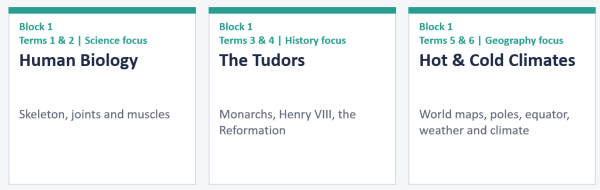
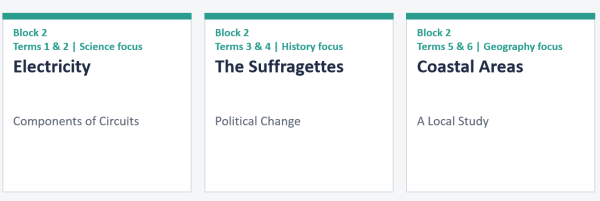
Students following the Foundation, Discoverers and Pioneers Pathways use the Equals semi-formal schemes of work for My World About Me. Key Stage 4 and Key Stage 5 Pioneers Students study science, geography and history-based learning through ‘World Studies’ lessons.
“Perhaps the reason for teaching The World About Me is best explained through the desire to extend [pupils’] understanding of learning beyond that which is immediately apparent. When asked for example, where chips come from, it is perfectly feasible that most learners with SLD would reply, assuming that they are able to reply at all – from McDonald’s; or where milk comes from – the fridge; or where water comes from – the tap. The principles we are concerned with might therefore be regarded as presenting a holistic understanding of everyday events, activities and experiences and about making the connections between these events, activities and experiences.”
(Equals Semi-Formal (SLD) Curriculum Schemes of Work: The World About Me, Basic Principles)
Schemes of Work
We use a combination of Equals Semi-formal schemes of work and supplementary schemes of work produced by Foreland Fields School. These are taught holistically throughout the curriculum. Pioneers from Key Stage 3, begin to access subject specific topic-based learning.
 Principles
Topics must engage the learners
- Topics must be relevant to the students' experiences and interests
- Primary learning is concrete: visit, touch and explore before books or screens
- Learning is contextualised within the topic, with revision and repetition
- Learners narrate their own understanding through project books and video diaries
- Pupils expand their learning according to their individual abilities
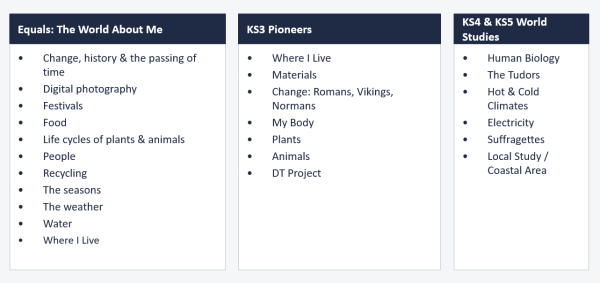
Equals Cross Curricular Learning
- Topics are not tied to age or key stage; learners move at their own pace within them
- Each topic is holistic: e.g. the water topic covers cooking, ice lollies and play
- Topics start with the world around the learner, so learning matters to daily life
- Topics are chosen for relevance, not to tick off National Curriculum subjects
- Concrete experiences, repetition and narrative support communication, memory and literacy
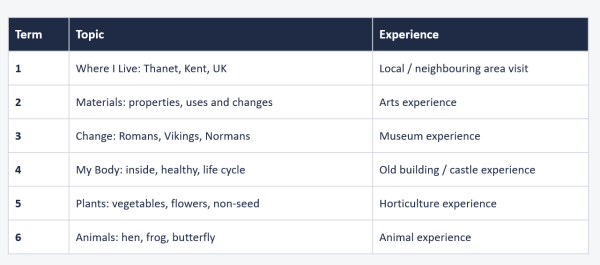
Key Stage 3 Pioneers Plan for The World About Me
Key Stage 4 and Key Stage 5 Pioneers Plan for World Studies