

Literacy for Life Curriculum
Foreland Fields School
Every child with a disability has the right to lead a full and decent life with dignity and as far as possible and to play an active part in the community.
(Article 23 United Nations Convention on the Rights of the Child)
We want our pupils to have every opportunity to develop the ‘literacy for life’ skills that they will need to be as independent as possible and to succeed in adulthood. We want our pupils to have equal opportunities to access information, leisure and friendships. We also want our pupils to learn to share our love of books and to enjoy accessing literature for pleasure in adulthood.
This document sets out our approach to teaching literacy across the school and encompasses communication, talk, reading and writing.
Literacy at Foreland Fields is led by the Communication and Literacy Lead alongside the Deputy Headteacher with responsibility for curriculum development. Pathway leaders have the responsibility for ensuring that students are receiving Literacy provision appropriate to their needs.
Challenges for our Students
Students with profound, severe and complex disabilities will have great difficulty acquiring Literacy skills. They have difficulty with abstract concepts and working memory and they are generally functioning at levels below the beginning of the National Curriculum. Our students are unlikely to become fluent readers or writers and some may never “read” or ‘’write’’ in the traditional sense of the word. Some students on the autistic spectrum (ASD) may demonstrate a decoding or spelling ability far higher than their level of understanding or their ability to compose sentences and this will not prepare them for being “readers” or ‘’writers’’ in later life. Our students follow a highly personalised learning journey, which focuses on developing the aspects of Literacy that will have the greatest impact on their quality of life in adulthood.
Some students however will attain a level of functional literacy and should be given every opportunity to achieve the literacy skills that will support them in life beyond school.
Steps to Literacy for Life at Foreland Fields School
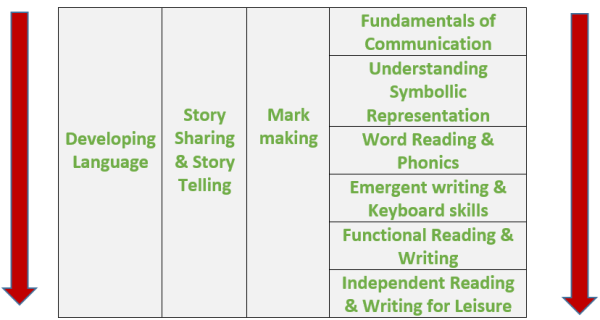
Developing Language
The Department for Education’s ‘Reading Framework’ (2022) and ‘Writing Framework’ (2025) emphasise the importance of developing talk when building the foundations for Literacy. At Foreland Fields School, we have adopted a ‘Total Communication’ approach, which supports students with a diverse range of need, from the earliest stages of development to independent and effective communicators.
Developing speech, language, and communication skills is fundamental to all learning across the curriculum. Our reading and writing strategies place a strong emphasis on oral development as an essential foundation for success.
Fundamentals of Communication – Intensive Interaction
Children’s first encounters with language are typically through talk; human brains are naturally wired to speak. Children at the earliest stages of development begin to learn the fundamentals of communication through back and forth ‘talk’ with a familiar adult or care-giver. This serve and return style of communication forms the foundations for all future learning. We call this ‘Intensive Interaction’.
Many of our pupils are at the earliest developmental stages of communication.
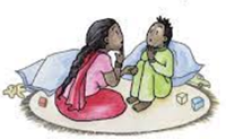 They have yet to learn the basic non-verbal communication skills (fundamentals of communication) that they need before they can begin to understand the abstract nature of words and language that are necessary to produce speech.
Intensive interaction provides rich process-based opportunities for pupils to develop the fundamentals of communication, that underpin all future learning.
Speech & Language Therapists (SALT), Occupational Therapists (OT) and the Communication team at Foreland Fields School can provide support and advice for individual pupils for all areas of communication, speech and language development.
‘Children’s back and forth interactions with adults…form the foundations for language and cognitive development. The number and quality of the conversations they have with adults and peers throughout the day in a language-rich environment is crucial.’
(DfE Reading Framework 2022)
Story-Sharing
Story-sharing sparks curiosity for all of our students. It strengthens their fundamentals of communication, as they enjoy sharing interaction with a familiar adult. It supports students to develop their vocabulary and introduces them to the ‘story language’ that they may use as story-tellers and writers.
Teachers at Foreland Fields School promote a love of reading, through daily story-sharing opportunities, tailored to the needs of each pathway and the needs and interest of each child.
Some curriculum pathways have identified suggested texts within termly plans and schemes of work. These may be adapted from year to year to meet the needs and motivators of individual cohorts and pupils.
Sensory Stories
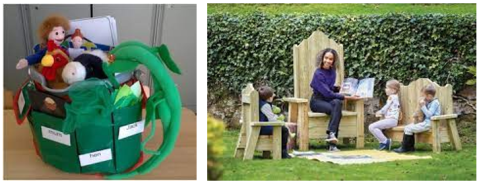
Sensory stories use motivating props and multi-sensory experiences to support pupils at the earliest stages of development to engage with narratives and to develop their understanding of vocabulary, story language and basic concepts.
Story buckets use the routines developed within Attention Autism sessions to support early learners to focus attention on the adult story teller. Pupils practise foundational literacy skills, such as joint attention, listening skills, anticipation and turn taking.
Our library has a full range of Bag Books story boxes available for use. The stories are told interactively through voice and emotion rather than words and pictures and feature simple story cards with tactile resources to support.
Frequent repetition of familiar stories gives pupils time to understand and to increase their participation, by anticipating or joining in with familiar words and phrases either verbally, using AAC or by exploring sensory resources.
Developing Understanding of Symbolic Representation
Understanding symbolic representation is a pre-requisite for being able to understand that text/writing has meaning. Children who have not yet grasped this are not developmentally ready for phonics, whole word reading, or letter formation.
We use a range of strategies to support students that are developing this skill.
Sensory Cues
Pupils at a very early stage of development, particularly those with sensory impairments, are taught to understand ‘sensory cues’. Pupils need to be given a consistent routine to help them begin to learn to distinguish activities and people so eventually they can begin to learn to anticipate what is going to happen to them. Some cues will be particular to individual pupils, for example, singing a particular song. Some sensory cues are built into the activity, for example, the smell of lunch or a coat for home time.
Object Cues
From these sensory cues, pupils can begin to increase the number of cues for the different activities about to take place. These can be the concrete objects that are part of the activity, for example, an object that is a cue for dinner should be the spoon that the child usually uses. It should be offered as a cue as lunchtime begins.
Objects of Reference
Pupils learn to make symbolic use of objects of reference where the object used is representative of the activity. For example, being shown a swimming costume before going to hydro. Pupils need to be around number 41 on the Welsh Routes for Learning Map (expresses preference for items not present via symbolic means) for objects of reference to make sense.
Symbolic Play
Children who are developing their symbolic understanding, may begin to represent objects through their play – for example building a house out of blocks; they may begin to produce ‘purposeful scribble’, or simple shapes in their drawing.
Child-led Play is a core element of the curriculum. Students are given daily opportunities to develop their symbolic play through activities such as:
- Construction
- Dressing up/role play
- Small world play
- Block play
- Art/creative activities
- Outdoor play
Reading Environmental Symbols and Signs
 Many students who are developing their understanding of symbolic representation, learn to read a vocabulary of photos, symbols and signs in the environment that have meaning to them. Consistent use of signs and symbols in the school environment and learning in the community, develops this learning.
Makaton Signing
Foreland Fields School has achieved ‘Makaton Friendly’ status and Makation signing is used across the school to support speech, language and communication. Ongoing training and resources are supported by our onsite Makaton tutor.
Some students with a hearing impairment may use BSL alongside qualified BSL intervenors. This is led by the Teacher of the Deaf.
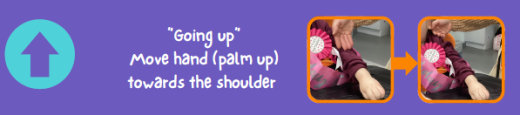
Adapted "on-body signs" are used with some students.
Communication Key Rings, Boards, Books and VOCAs (AAC)
Symbols used in school are generated using InPrint software. We have bank of agreed timetable and activity symbols to ensure consistency across the school.
Pupils who are able to read signs and/or symbols have access to a range of AAC (Augmented assisted communication) within our Total Communication environment.
Adults wear key symbols on their lanyards to support with receptive language around transitions; students have access to core symbol supported communication boards where appropriate in class and individual pupils have personalised symbol supported communication books.
Symbols are also used to support pupils who use other forms of AAC such as Voice Output Communication Aids (VOCAs).
The KMCAT team support some of our students at a specialist level. These students often benefit from a high-tech solution to access communication. These students are assessed, and in some cases have equipment provided and monitored by a multi-disciplinary team.
AAC
|
Sign |
Symbol |
Switch |
VOCA |
|
Makaton BSL SSE (sign supported English) to support Literacy skills for BSL users. |
Single symbols Symbol supported signage Communication board Communication book Symbol supported texts |
Touch Screen Single Switch Double Switch Eye Gaze
|
Super Talker/Tech Talk Big Mac switches iPad apps - Proloquo2Go - Grid for iPad - SuperCore 50 - Textspeak
|
Mark Making
Students begin to engage in mark making, before they have developed an understanding of symbollic representation. Initially they may enjoy the physicality of moving their arms or hands through a sensory medium, or moving a mark making tool across a surface; this begins unintentionally and becomes more purposeful as a child develops their understanding of cause and effect.
Children need to develop a range of gross and fine skills, before they are ready for writing. At Foreland Fields School, students are given daily opportunities to develop the motor skills that they need for life, through play-based activities.
These include:
- Sensory exploration
- Messy play
- Block play and construction
- dressing up/role play activities
- outdoor play/climbing
Developing Functional Mark Making
As students practice mark-making many of the visual representations they create have meaning to them. A few squiggles can represent a name or faces become people who are part of a story to retell. Some students will be able to explain their drawings and they often become more consistent over time.
Story-Telling
My Narrative
Pupils with developing language become tellers of their own stories by listening to, joining in with and rehearsing stories, poems and narratives told by teachers. Drama, role play and call and response type activities provide further process based opportunities to bring stories to life, to explore new language and concepts and to rehearse and consolidate learning across the curriculum. Teachers use the Equals schemes of work My Drama and My Narrative.
Tales Toolkit
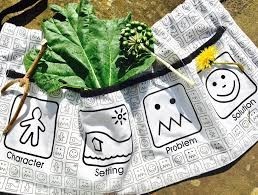
 Tales Toolkit supports early language and social development through child-led oral story-telling. Adults create interactive story-telling sessions, using props or pictures that are relevant to the children’s own experienxces. Stories are structured around 4 key elements – character, setting, problem and solution – each represented by simple symbols to support understanding and recall. Tales Toolkit can also be used to introduce visual story making – or story maps.
Students can also begin to use the structure to tell their own stories which often involve real-life problems and solutions.
Talk for Writing

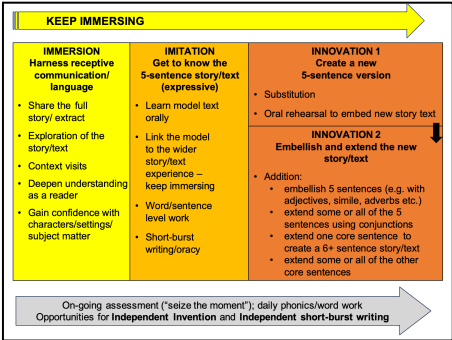
Talk for Writing builds on the principles of Tales Toolkits and supports children with developing story language by focussing on internalising language and story structures through oral rehearsal. Children are ‘immersed’ in a text through story sharing, play, art and other rich creative experiences, before they learn to imitate the story and then begin to make their own stories by innovation. Teachers model writing through story maps and shared and guided writing sessions. Talk for writing can be used for Fiction and Non-Fiction Texts.
Initially a 5 sentence text model is used and children work on developing understanding of genre, style, key language structures, spelling, vocabulary, grammar and sentence composition, through short-burst writing activities that include word and sentence level tasks.
Word Reading and Phonics
Social & Environmental Signage
Pupils who are developing an understanding of symbollic representation are taught to read familiar social and environmental signage in real-life contexts, (such as, ‘pull’, ‘push’, ‘danger!’) that will increase their independence.

Pupils are taught to read words by sight that have personal importance to pupils, such as names.
Pupils learn to read numbers in real-life contexts that will increase independence with cooking, shopping, travel, leisure and social activities.
Phonological Awareness (including pre-phonics skills)
Phonological awareness refers to the ability to recognise and manipulate the sounds of spoken language, including words, syllables, onsets, and rimes. It is crucial for speech sound production as well as supporting reading and spelling development.
The All Aboard Phonics Phase 1 resources are a useful starting point. The fundamental skills can be implemented across the full range of curriculum areas and through play.
The resource features 7 aspects which can be explored from Early Years upwards. Research shows that continuing to have opportunities to develop phonological awareness skills even for established readers can increase competence and understanding.
- Environmental Sounds
- Instrumental Sounds
- Body Percussion
- Rhythm & Rhyme
- Alliteration
- Voice Sounds
- Oral Blending and Segmenting
All Aboard Phonics
 At Foreland Fields School we use All Aboard Phonics programme to teach phonics to pupils in all Key Stages who are able to discriminate sounds and understand symbolic representation. All Aboard Phonics uses the synthetic phonics method, which means that the phonemes are taught first and then pupils are taught to blend these phonemes together to say words. The programme follows a systematic approach, meaning that the phonemes are introduced in a specific sequence.
In All Aboard Phonics, all the main sounds of the English language are taught and each sound is introduced with a character called a pictophone. This is a memorable, visual prompt to support phonemic awareness. For example, the ‘Toad About to Explode’ represents the /t/ sound and the ‘Oon on the Moon’ represents the long /oo/ sound. Pupils initially learn each letter by its sound, not its name. This supports pupils to blend sounds to form words in the early stages.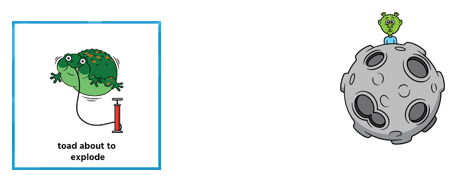
Our reading scheme consists of decodeable, colour banded books, linked to the All Aboard Phonics phases. Staff support students to select books that they are able to access according to assessed phonics and decoding levels.
Typing Skills
Some students develop typing skills to locate specific websites, programmes or links on YouTube. These skills can be used to support students to choose activities to explore in their leisure time on a range of devices. Using predictive text on a device that has previously found a favourite activity can make this process much quicker.
Some students who are developing their use of initial sounds in phonics can begin to use this knowledge to explore dictionaries and word-lists. This is particularly useful for students who have access to a high-tech VOCA as they can search for symbols more efficiently when stored in A-Z folders on their device.
Functional Literacy and Comprehension
Teachers provide a rich variety of real-life opportunities for pupils in all Key Stages to develop their literacy for life and comprehension including:
- Social & environmental signage in the community
- Use of technology, such as email, social media, online shopping, wtching you-tube
- Shopping related reading and writing, such as lists, signage and prices
- Travel related reading, such as timetables
- Recipes and instructional texts
- Writng cards, labels and messages
- Reading for information, such as newspapers and magazines
- Filling in forms
- Reading for leisure and visits to the local library
- Creative writing
Foreland Fields School has a library for students. Good quality non-fiction books are clearly colour-coded by category. Fiction books, audio books, Big books and BagBooks are available for use in class. New books are added each year in consulation with our local bookseller partner - Happy Reading Children's Book Shop in Broadstairs.
Reading Accreditation
Pupils work towards accreditation in reading that is appropriate for their needs. Pupils may work towards AQA units in Key Stage 2 or above such as :
- Interactive story telling
- Early readingand listening skills
- Readingand using symbols to control the environment
- Early readingskills
Some pupils work towards English Entry Level Certificate and some may work towards a Level 1 English qualification.
Engagement with Families
Families play a crucial role in developing their child’s literacy for life skills. Teachers share videos of class books and stories with families on Class Dojo. Evidence of pupil progress in reading is shared through the Evidence for Learning App and parents are encouraged to share evidence from home.
Sharing stories at home is encouraged across all pathways to promote the shared experience of a love of sharing books. This may be in the form of learnt stories and rhymes, a favourite book read over and over or a book from school to show developing reading skills.
Information for families can be found on the school website.
https://www.foreland.kent.sch.uk/teaching-and-learning/phonics-programme/
Related Documents
Foreland Fields Curriculum Handbook
Foreland Fields My Reading Scheme of Work
Foreland Fields My Writing Scheme of Work
Equals Semi-formal Schemes of Work (My Communication, My Narrative & My Drama)
Equals Informal Schemes of Work (Adventurers)
Welsh Routes For Learning Routemap
DfE Reading Framework 2022
DfE Writing Framework 2025
Uninted Nations Convention on the Rights of the Child
Talk for Writing Publications