Outdoor Learning
Outdoor Learning
Education must develop every child’s personality, talents and abilities to the full. It must encourage the child’s respect for human rights, as well as respect for their parents, their own and other cultures, and the environment.
(Article 29 United Nations Conventions on the Rights of the Child).
We want every pupil to have the opportunity to build life long skills needed to access the outdoors safely, independently and to flourish in adulthood. We want our pupils to learn about the benefits to both physical and mental health when interacting with nature. We also want our pupils to experience the awe and wonder of the outdoor environment and learn to respect this environment through caring about the people, animals and plants they experience on their journey in the great outdoors.
This document explores how outdoor learning sits at the heart of the school’s vision – with a pupil centred approach, linking to all the areas of the curriculum, transforming the natural world into a powerful classroom.
The Outdoor Learning/My Outdoor School is led by a qualified Forest School and Coastal Leader alongside the Deputy Headteacher with responsibility for curriculum development. There is also a ‘Special Interest Group’ for outdoor learning who meet across the year to ensure that pupils are receiving outdoor provision appropriate to their interests and needs.
Enhancing Learning and Wellbeing Through Outdoor
At Foreland Fields School we embrace personalised learning and recognise each pupil’s unique strengths and challenges. We understand how removing the four walls from a classroom can offer our pupils rich opportunities to engage with their environment and support, develop and help them to thrive both physically and mentally. Pupils can develop at their own pace in areas such as confidence, resilience, social skills ,communication, growth mindset and respect and also through play exploration and sensory engagement. All outcomes are central to Foreland Fields’ aspirational and Rights Respecting ethos.
Steps to Outdoor Learning for Life at Foreland Fields School.
We strive to maximise every learning opportunity in the outdoors through exploring outdoor spaces, off-site visits and sensory experiences that are woven into the curriculum to support holistic development for every pupil. It is vital to prepare both staff and learners before starting out. Learning to pack the essentials, dress for the weather and develop independence and organisational skills. It is also important that all our pupils learn these skills in context through the ‘why’ and the ‘how’, the ‘know how’ and the ‘doing’. (the fundamental pillars of learning).
The issue of selecting appropriate clothing is also linked to ‘My Travel Training ‘. This is also important in My Outdoor Play through staff modelling enthusiastic engagement whilst modelling dressing in suitable clothing and footwear. Providing pupils with appropriate alternative clothing in known spaces will prepare them for My Thinking and Problem Solving, communication, independence in dressing and undressing for a wide range of weather conditions throughout the seasons.
The Government’s Children & Nature Programme: the importance of integrating time spent in nature at school has identified the importance of outdoor learning through ‘living nature’.
“We share an aspiration to create healthy, happy societies. One mechanism for achieving this is by improving the connection people have with nature, which provides better mental and physical health. For children, the effects are more profound, with a wealth of evidence showing those who spend time outside connecting with nature see improvements in school attendance, behaviours, academic achievement, and social skills like teamwork” They support nature recovery and removing barriers to accessing nature and spending time in nature. At our school we are widening our pupils’ world, increasing opportunities to access their community, developing their social communication skills and independence across all pathways.
My Outdoor School Schemes of Work
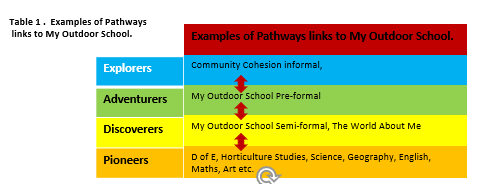
To reiterate the importance of ‘My Outdoor School’ in the Equals Schemes of Work. “Our pupils have difficulties with generalising skills and concepts and in order for learning to be meaningful and successful, opportunities for holistic development are presented in real life contexts, where pupils can learn by “doing” and practising the skills that they will need to be happy, healthy, safe and successful in their life beyond school.” Each pathway will have its own unique framework for the pupils. However, there is no reason why Pre-Formal, Informal, Semi-Formal and Formal learners should not enjoy some aspects, of outdoor learning together, promoting inclusive practice. Sharing weather experiences, sensory nature sessions and play, would be the perfect opportunity to join together. Other outdoor learning sessions can also look very different according to pathways. It essential to understand that outdoor learning is not a standalone subject. It is cross-curricular and will integrate with any subject while also improving mental health and well-being for both pupils and staff.
Staff and Learner Preparation
The Leader’s support bag is vital to pack correctly in preparation for the outdoors regardless of the environment visit. This is where the essential documentation, medication, first aid and resources needed for the session are held. It is important that both adults and pupils are aware of the contents of this bag. This is an excellent opportunity for the leader to model the preparation and organisation of preparing an outdoor learning visit to develop these skills with the pupils.
Building upon skills from ‘My Play and Leisure’ pupils will need to observe and discuss the weather conditions and learn about suitable clothing and essentials required when dressing and preparing for the weather.
Packing the bags. Pupils can learn what they need to pack in their bags and pack them with support at first, then developing their knowledge and skills in locating, organising and packing their own bags independently throughout the seasons. This will encourage decision making linking to ‘My Thinking and Problem Solving’.
Creativity
Core Principles of "My Creativity" in the Equals Curriculum are immersed in sensory engagement, freedom to express preferences and choice, communication and interaction through music, storytelling, role play and art. The emphasis is on the ‘creative process’ rather than product based, ‘play-based and process-led’. The learning is personalised ensuring that pupils continue to develop in their own way at their own pace. This life long learning journey also promotes self-awareness, resilience and confidence with support for personal aspirations.
Wilderness Explorers
To identify life lived in the outdoors through a range of activities. Increasing caring skills and knowledge for the environment, through being kind and considerate to the natural world and everything in it . This could also include things that should not be found such as litter and awareness of footfall damage that people can create.
Environmental Awareness
Pupils can learn about how to look after the environment, make homes for animals, make bird feeders, protect and grow plants and maintain the outdoor school environment. This gives context to the learning and also develops life skills and the importance of responsibility to care about their community and everything in it.
Seasonal Awareness
Seasonal awareness is to experience the outdoor school all year round. Looking at how the environment changes and the passing of time. As mentioned earlier when preparing for the outdoors and starting out, our pupils will learn to dress appropriately for the season. They will also develop their independence skills through getting ready for the outdoors with clothing, footwear and packing essentials that they need to engage in seasonal activities.
Shelter Building
Shelter Building incorporates the three pillars of the rigor and play model, where pupils learn the ‘why and the ‘how’, ‘the ‘know how’ and the ‘doing’. See Diagram 2, Understanding that we need shelter to stay dry, at the right temperature, in the right place safely is a valuable life skill. Shelter building also promotes social communication and teamwork. It is important to pack the equipment and materials to make a shelter as well as gathering natural resources respectfully to make a natural shelter. ‘My Thinking and Problem Solving’ skills will be challenged through this process as making the shelter stable, secure, weather proof and large enough to accommodate the right number of people will be at the centre of the process with an end product. Shelter Building also includes building them for animals too. The skills in ‘doing’ this task are complex as the pupils will need to think about the habitat of the animal:- do they live on the ground?. up a tree?, on land or in water? are just some of the questions they will need to consider.
Making a Fire
The making of fires is fully risk assessed which includes scrutinizing individual pupil’s Health Care Plans and Behaviour Support Plans, and adding these to the risk assessment with measures in place to reduce risk. The leader also ensures they pack fire safety equipment and first aid items to treat burns. The fire circle rules are discussed with the pupils before a fire is lit. Pupils are encouraged to consistently walk around the fire circle and not across it before a fire can be lit. A fire is supervised at all times and pupils wait until they are invited up to the fire. Pupils are supported and positioned safely at the fire side. All fires are extinguished and checked to leave no trace or damage to the environment.
Cooking in the Outdoors
The Leader has been trained through The NVQ3 Forest Leader and Coastal Leader in managing food hygiene and cooking a range of recipes to support pupils to experience cooking on an open fire.